

Executive Summary
Yet austerity has affected all areas of SEND provision including being able to provide the right facilities for children such as outdoor spaces which are widely recognised as key to helping children with SEND to learn, thrive and regulate their emotions.
Good and safe outdoor play areas also help improve gross and fine motor skills, mobility and coordination, balance and spatial skills and offer children a safe place to burn off energy and let their imaginations run wild.
The good news is that the government has announced an overhaul of the SEND system with its White Paper: Every Child Achieving and Thriving2 which wants to see a more inclusive model by 2035 where outdoor spaces will provide both a therapeutic and learning environment for SEND pupils.
This shift in focus on improving outdoor facilities is backed up by a growing body of evidence showing outdoor space is no longer optional for SEND provision.
The importance of well-designed outdoor areas, including weather-protected outdoor space, is now recognised as integral to helping SEND pupils learn and to regulate their behaviour.
This paper aims to help schools understand the importance of well-designed outdoor space and the availability of covered space for teaching and managing children with SEND and to highlight the potential of outdoor environments in supporting improved behaviour and focus among children with SEND.
Context & Background
The UK Special Education Needs and Disability (SEND) Code of Practice (2014)3 defines a child or young person as having SEND if they have a learning difficulty or disability that requires special educational provision.
This may relate to a wide range of areas, including communication and interaction, cognition and learning, social, emotional and mental health, sensory or physical needs.
Outdoor learning offers valuable educational benefits for children with diverse emotional, cognitive and behavioural needs.
However, schools trying to provide SEND teaching and learning have suffered from increasing budget pressures at the same time as there’s been an increased awareness of SEND with more children diagnosed, leading to even more pressure on mainstream and special schools.
This has created a perfect storm with an increase in number of Education, Health and Care Plans alongside those children identified by schools as needing SEN using their own budgets which can often rely on costly private provision, leading the SEND system to near breaking point.
An ITV investigation4 in 2024 found that nearly a third of parents whose kids have special needs had to use the law to get them the support they need, and that well over half of SEND pupils have been forced to take time out of school.
Core Problem
As the government acknowledges in its White Paper, SEND is a design issue as well as an educational problem.
There is a clear link between environment, regulation, behaviour and learning readiness.
If the physical environment of the schools isn’t fit for purpose, then it can affect outcomes for all students, not just those with SEND.
Many traditional school environments fail SEND pupils because they are often very busy and noisy, conditions unconducive to learning especially for students with certain disabilities such as autism and Attention Deficit Hyperactivity Disorder (ADHD).
And while outdoor space may be available to everyone, it may not be suitable for SEND pupils who need specialist equipment and space to themselves.
If children with SEND aren’t given the chance to learn in a calm environment and to regulate their behaviour, then they can’t be expected to reach their full potential and thrive.
What does the Whitepaper propose around outdoor space?
While the core focus of the Government is on systemic reforms, they are also pushing for inclusion by creating accessible and therapeutic outdoor spaces.
The White Paper serves as a framework to ensure schools offer high-quality, inclusive environments, which include the provision of stimulating and calming outdoor spaces to support learning and well-being.
These include:
- Sensory and Therapeutic Spaces: The focus is on improved SEND provision such as creating sensory gardens and quiet, safe outdoor areas designed for regulation and reduced sensory overload.
- Access to Play: The proposals encourage strengthening inclusion in mainstream settings, which involves upgrading facilities to provide outdoor areas that accommodate physical, social, and emotional development.
- Expansion of Facilities: New SEND provision at primary schools, linked to the White Paper reforms, includes building new specialist facilities, such as those at Stanground School5, designed to improve the educational experience for children with SEND.
- Community Use: There are recommendations for schools to open playgrounds and outdoor spaces for community use outside of school hours to improve access for children with SEND.
- Inclusive Design: The reforms place emphasis on incorporating inclusive equipment and structures, such as accessible climbing frames, in school layouts to improve physical activity and social skills.
In addition, at the end of 2025, the government announced £3 billion6 in funding, over four years, to create 50,000 places for children and young people with SEND in England.
The money, it said, would ‘fund a landmark expansion of specialist, calm learning spaces within mainstream settings.’
What does the evidence say about outdoor space and SEND?
There is a wealth of research showing children with and without SEND benefitting greatly from learning outside. Not only does their attention and engagement increase but their overall wellbeing also benefits with lower stress levels.
The Impact Of Outdoor Learning On Social And Cognitive Development In Special Needs Education: A Systematic Review7 published 2025 looked at a number of studies into the relationship between outdoor play and the behaviour of children with SEND.
The researchers concluded that outdoor learning enhances children’s academic performance, social communication, and wellbeing and that accessible and inclusive opportunities for outdoor learning are essential for children with SEND to experience these benefits.
They found that outdoor education promotes a more inclusive learning environment compared to traditional indoor learning environments.
Less disruptive behaviours and better concentration
In one study, students who took part in an outdoor education programme, showed decreased disruptive behaviours and enhanced attention spans while maintaining comparable academic performance in science relative to a control group.
Students with disabilities were also observed to be more focused on educational tasks when working outdoors.
Reduced anxiety and increased social skills
The review also included a study into children with ADHD revealing natural environments offer a more inclusive educational approach for children with SEND by reducing and containing anxiety and enhancing social skills through activities and teamwork.
The researchers found that spending time doing activities in natural environments, compared to urban areas, can reduce ADHD symptoms like inattentiveness with lasting positive effects.
Increase in pass rates and a positive attitude
In a further study, a two-year garden intervention programme for children with disruptive behaviour disorder, the schools saw an increase in pass rates, positive attitude and lower dropout rates.
Outdoor learning leads to better verbal communication and improved focus
More recently, researchers have also identified benefits of outdoor learning for children with Autism Spectrum Condition (ASC) and the need for adaptations to ensure accessibility.
Researchers conducted a five-month case study on the effects of using an outdoor classroom on two special education teachers and five autistic children and found children experienced increased verbal communication, reduced over-stimulation and improved focus on tasks, all contributing to progress towards their Individual Education Plan (IEP) goals.
Sensory gardens and multi-sensory outdoor environments
Sensory gardens commonly include a combination of plants, trees, and flowers with interactive and developmental features like textured and colourful paths, water features and interactive musical instruments and sound boards, animal figures, and different coloured roofs.
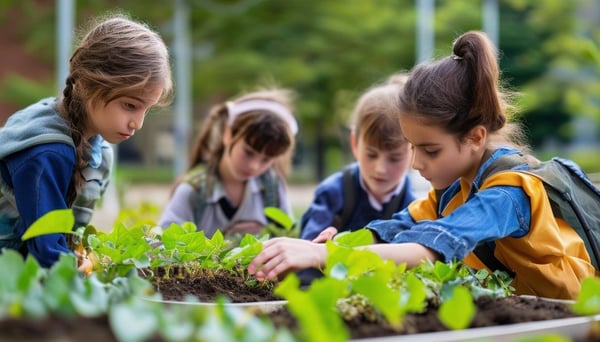
Raised bedding planters are also popular, so children can get involved with digging, watering and harvesting.
Children with SEND love sensory gardens and multisensory outdoor environments because they stimulate and encourage them to explore their senses whilst burning off energy.
This is especially true if children can have some control over the sensory environments and play equipment according to a study The use of Multi-Sensory Environments with autistic children: Exploring the effect of having control of sensory changes8.
Researchers showed giving autistic children control of the multi-sensory environment reduced their repetitive motor behaviours, sensory behaviours, activity levels, stereotyped speech and vocalisations, and increased their attention.
Their findings back up other studies identifying the importance of control for autistic children.
Nature exposure and reduced anxiety
Innately, we understand that being outside in nature is therapeutic and calming, taking the time to listen to the sounds of birdsong and nature.
A growing body of research9 has found that children who spend more time in green spaces, such as wooded playgrounds or gardens, have better focus, lower stress levels and better emotional resilience.
This is especially the case for children with SEND to escape the stark artificial light of many schools and noisy classrooms.
Attention Restoration Theory (ART)10 suggests that concentration can be improved by time spent in, or looking at nature and helps provide a restorative effect by being immersed in our surroundings.
If children suffer from anxiety, being outside in nature helps to calm them and builds confidence in a non-academic environment and provides mindfulness opportunities to help them regulate their anxiety.
Forest school approaches
Forest schools work well with children with SEND because the ethos isn’t about everyone working at the same level.
Instead, children are able to learn and develop life skills at their own pace through exploration, risk-taking, and reflection. Overall, learning in nature helps children to improve confidence and develops communication and social skills as well as improving motor skills.
For children with autism, forest schools provide predictable routines in unpredictable settings, sensory regulation opportunities and reduced social pressures, though, at the same time, offer children more authentic interaction.
Pupils can also be encouraged to explore their special interests such as collecting and categorising natural objects.
For children with ADHD, being outside is a great way to channel energy while the natural environment has been shown to reduce hyperactivity.
And for those with communication difficulties, being in nature presents lots of visual and tactile learning opportunities.
Structured playgrounds and sports pitches vs unstructured outdoor space benefits
Structured playgrounds and sports pitches are great for children who have good social skills and can play organised games.
Playgrounds that include SEND sensory equipment and playground furniture are also brilliant in helping children to interact with each other and calm their behaviour as well as burn off energy.
But it’s also important to have unstructured outdoor space where children can play freely.
Providing a special outdoor space for children with SEND can stimulate creative play, allowing their imaginations to run wild through colouring, painting, drawing or playing with sand and water.
Policy & Design Guidance
There are a number of factors that schools need to be aware of in order to implement the government’s recommendations around outdoor space.
Firstly, you will need to refer to the DfE Building Bulletins (BB104), the non-statutory guidance for area requirements in SEND and alternative provision (AP) settings in England.
It applies to special schools, AP, non-maintained special schools, and specialist units attached to mainstream schools and provides calculations for total site areas, teaching spaces, and therapeutic areas to support pupils with complex needs.
You will also have to think about inclusivity, safeguarding and accessibility expectations and how your outdoor provision fits into capital funding and compliance.
The problem with existing outdoor spaces
Currently many outside spaces can only be used in good weather which considering how much rain falls in the UK, isn’t the best option for our children.
A lack of any sheltered transitions between the outside and inside can make it even more unappealing for children to go outside.
Playgrounds also fail to take into account children with SEND who may find a traditional play equipment overstimulating or may physically be unable to play with any of the equipment.
Many playgrounds don’t include any zoning or very little zoning for children with SEND.
In addition, older playgrounds can cause concerns around safety with equipment that is fragile or has sharp edges.
Furniture that invites climbing can also be a problem for children with SEND especially if they are unsupervised or the sightline is poor for the playground supervisor. These all add up to safeguarding risks for children.
Finally, across the UK there’s a dearth of suitable covered spaces in playgrounds which would allow children to play all year round.
Design principles for SEND-appropriate covered outdoor spaces
There are a number of design principles schools need to follow to provide covered outdoor spaces appropriate for SEND students.
Safety & robustness
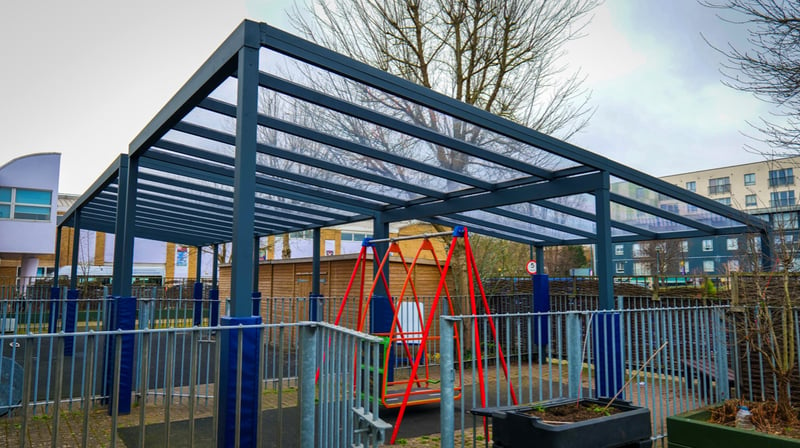
Non-fragile roofs, concealed fixings, smooth profiles, anti-climb design, post protectors.
Calm sensory environment
Diffused light, acoustic considerations, predictable layouts.
Clear zoning
Quiet spaces, active areas, social spaces, learning zones.
Supervision & safeguarding
Sightlines, lighting, enclosure without feeling institutional.
Accessibility & inclusivity
Level access, circulation, wheelchair-friendly layouts.
Why covered space is critical in SEND settings
Providing covered space in a school playground is one of the vital areas outlined in the Government’s White Paper.
Research11 shows that autistic individuals are at a higher risk of obesity and higher body mass index (BMI) due to inactivity and sensory-avoiding behaviours and are more likely to have poor fitness levels and underdeveloped motor skills as well as Vitamin D deficiency from not spending enough time outside.
Covered spaces allow children to access the area at predictable times, not just when the weather dictates outdoor play which is very important for SEND routines and self-regulation.
They not only protect children from the rain but also from the heat which is becoming more of a problem in our warming climate, when heatwaves are expected to become more frequent and last longer.
Canopies provide shade, glare control and thermal comfort on hot days with reduced sensory load compared to busy indoor areas.
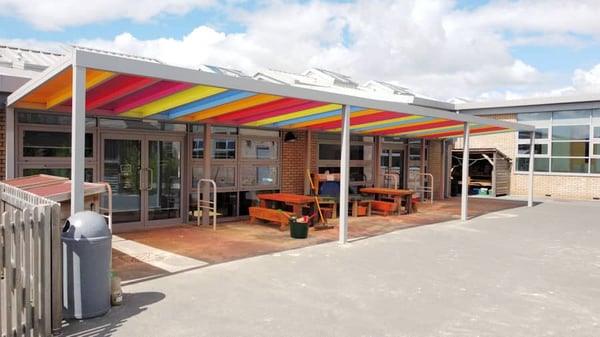
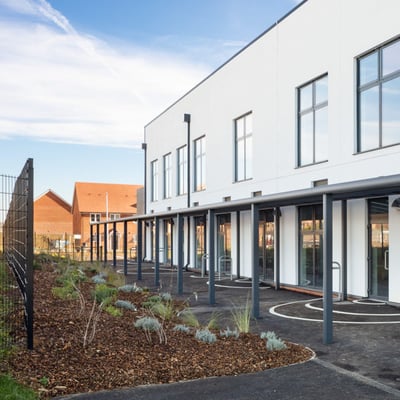
The structures can be open sided, standing alone over an outdoor playground or as walkways between buildings or attached to the outside of the building.
They are perfect for providing a safe, calm transition zone between indoors and outdoors and are used to support outdoor learning, therapy, quiet time and social eating.
How schools across the country use canopies
Canopies are a very popular way of transforming playgrounds or unused areas into multi-functional all-year round spaces such as Trinity C of E Primary School.
They provide an attractive covered area for play equipment and outdoor activities such as painting, gardening, or messy play in many schools such as Folly View Primary while others like Great Bedwyn School opt for bright coloured roof panels.
Schools such as Paddock SEND School also use canopies as calm down spaces and to help children regulate their behaviour.
They are also perfect for small group learning outside the classroom such as at Billingshurst Primary Academy, part of the Sussex Learning Trust, and for therapy and intervention sessions
Many schools incorporate canopies into the school to provide extra dining or break time space away from the school such as Chichester Free School and at Warden Park School
Canopies are also used as transition spaces for pupils who struggle with busy corridors and can be used as walkways like at Dene Magna School.
Additionally, canopies can be combined with shade sails, a fabric covered area which can come in different colours and shapes, to complement outdoor learning and play like at Aldwickbury School and The Deaf Academy.
Finally, canopies can also be fitted or retrofitted with solar panels such as at Three Peaks Academy to help you cut energy bills and carbon emissions whilst helping children learn about renewable energy.
Long term value: Outcomes, Inclusion, Investment
Canopies can provide improved engagement, better attendance and wellbeing while reducing behavioural incidents.
Installing a canopy also helps to reduce pressure on indoor spaces which can be noisy for children with SEND and gives them somewhere to escape to for some calm time.
They are popular with schools because they are long-lasting and tailored to your exact needs; and can be fitted in hard to reach unused areas such as courtyards, expanding the amount of useable space.
Their flexibility and adaptability means you can add walls, lighting, heating and even solar panels to turn the canopy into a different space if your needs change.
And because of their functionality, canopies perfectly align with inclusion, wellbeing and SEND strategies of schools.
Installing a canopy also means a school is using capital funding rather than any revenue by using the space you have in a more productive and functional way.
Conclusion
It’s important that schools now follow the government guidance and the wealth of evidence to make adaptations to outdoor space to ensure accessibility and inclusivity for children with SEND.
By doing so, schools can enhance the amount of time spent outside to support their unique developmental needs.
However, it’s crucial to make sure that you choose the best options for children, staff and your budgets.
Kensington Systems has been installing safe and well-designed Spaceshade canopies and shade sails for SEND outdoor spaces for many years and our experts would be very happy to talk through your needs.

Sources:
2. White Paper: Every Child Achieving and Thriving
3. https://www.gov.uk/government/publications/send-code-of-practice-0-to-25
4. ITV investigation reveals shocking scale of special educational needs crisis across UK
5. Stanground School5 example.
6. Hansard