Many schools around the world are used to dealing with the multiple impacts of overheating.
However, schools across the UK are just beginning to grapple with the problem due to climate change.
Impacts vary widely depending on the school building design, but can cause both mental and physical health problems for pupils and staff, leading to behavioural issues.
On top of this, overheating can lead to organisational chaos with having to reorganise timetables or classrooms at the last minute to avoid the hottest part of the day.
Modern buildings are prone to overheating
Recently, the Department of Education (DfE) commissioned research from scientists at University College London (UCL) and the Met Office into school buildings’ resilience to heatwaves.
The researchers examined data on 20,000 schools and discovered those built from 1960s onwards are particularly prone to overheating.
This is mostly because they are designed to keep heat in through insulation. In addition, they often have large windows, attracting solar glare, which cannot be opened very widely because of safety issues.
Heat exhaustion can lead to heat stroke
Children are especially vulnerable to overheating because their bodies are less able to regulate temperature.
They sweat less than adults, yet they need to drink more water. However, young children may not recognise they are thirsty, and therefore they are in danger of dehydration and heat exhaustion, leading to heat stroke.
Heat exhaustion begins gradually with a headache, nausea, dizziness and confusion, loss of appetite and sweating. Symptoms also include cramps in the arms, legs, or stomach, a fast but weak pulse or paler than normal or clammy skin.
Heat stress can lead to heat stroke, a medical emergency, when the body reaches a dangerously high temperature, often above 40°C.
Additionally, overheating can also exacerbate pre-existing medical conditions such as asthma, heart and kidney conditions, epilepsy and anxiety.
Concentration goes out the window
Students learn best at a comfortable temperature between 18 to 22°C.
But once the mercury begins to rise, students and teachers begin to lose focus with 26°C recommended by the National Education Union (NEU) as the maximum temperature for classrooms.
Overheating can also lead to lethargy, irritability and anger, poor decision making causing increased behavioural incidents in children with teachers finding it increasingly difficult to deal with the heat and bad tempers.
This is especially the case for younger children who can’t always vocalise how they feel and for those children who have suffered sleepless nights because of hot, stuffy homes.
Heated breaktimes and lunchtimes
Students naturally want to spend time running around outside with their friends but schools may have to limit the time they spend in the playground to cooler mornings.
If it is too hot outside, they will have to be supervised inside somewhere cool and if there isn’t enough suitable space inside, teachers may find it tricky to maintain order and control children who may feel irritable because of the heat.
Reorganising the timetable and classrooms
Classrooms facing south and west have the biggest issues with overheating unless the windows are protected from solar glare.
It may be necessary to vacate classrooms with large unprotected windows and move lessons which may cause overcrowding in cooler rooms.
This is even more of a problem during the exam season when children and teachers have to stay on the premises.
School closures
Over the last few years, some schools have had to close for part of the day because overheating posed a significant health risk to students and teachers.
This obviously has a huge impact on parents and carers at work who have jobs where it’s difficult to leave earlier than planned as well as children losing out on learning.
External shading keeps classrooms cool
The Department of Education and UK Health Security Agency (UKHSA) both recommend shading sun-facing windows to stop overheating.
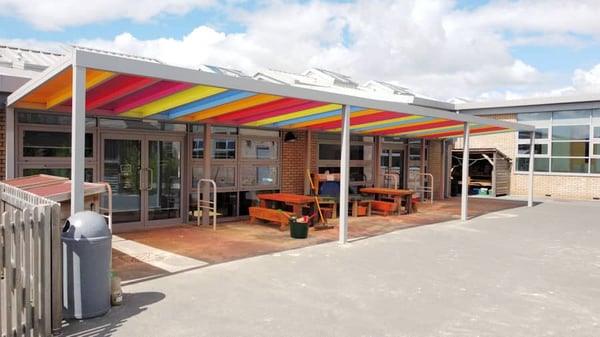
External shading is the most effective and sustainable way of stopping overheating happening in the first place. This can be with canopies, shelters or awnings (for ground floor windows) or external blinds, shutters or brise soleil.
This is why schools in hotter climates have been fitting external blinds and brise soleil to the outside of south and west facing windows for many years.
External blinds reduce the temperature inside by 40 per cent but still allow light into the room, while their special weave allows occupants to continue to see the world outside.
If you would like to find out more about how external blinds can stop overheating, please contact us.
Read the full whitepaper on dealing with overheating in schools