

Schools, hospitals, leisure centres and commercial businesses often install canopies as a cost-effective way to create extra space.
But the type of roof you choose for your canopy will depend on how you plan to use the new area.
Polycarbonate Roofs
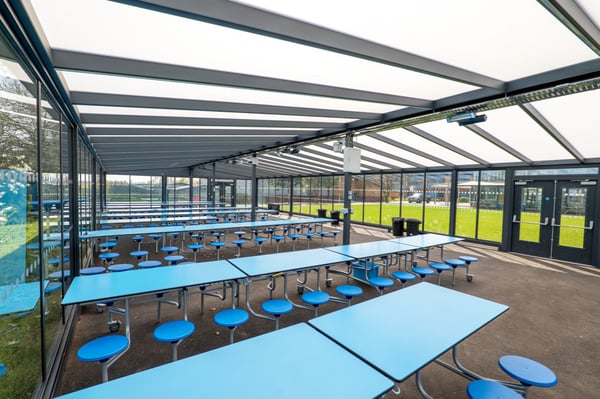
Polycarbonate roofs are fitted to aluminium and timber-framed canopies of all shapes and sizes used as walkways, dining rooms, storage, entrances or outdoor play areas.
The canopy modular design means they are perfect for awkward or hard-to-reach spaces, such as courtyards and are easily tailored to meet your specific needs.
Plenty of light
Opal polycarbonate is our most popular choice for canopy roofs. It has a milky appearance to prevent solar glare but still allows plenty of light to come into the canopy.
Protection from the sun
The panels have a double UV-protective coating which blocks 98 per cent of all the most harmful UVA and UVB rays, making it ideal for multiple uses in various settings such as schools and hospitals.
Rainproof
A polycarbonate roof will keep you dry, however heavy the rain is, allowing you to use the canopy in all weather conditions and throughout the year.
Minimal maintenance
A polycarbonate roof needs minimal maintenance. You will need to remove any debris, like leaves or mould and mildew, as well as bird mess from the roof, just like with any other structure.
But the panels are very easy to clean with a soft brush and an eco-friendly detergent.
Produce your own energy
One of the biggest bonuses of our polycarbonate roofs is that they are strong enough to take solar panels.
So, they can be added at the time or retrofitted when budgets allow, helping you to reach your carbon-neutral journey and slash energy bills.
Fabric Roofs
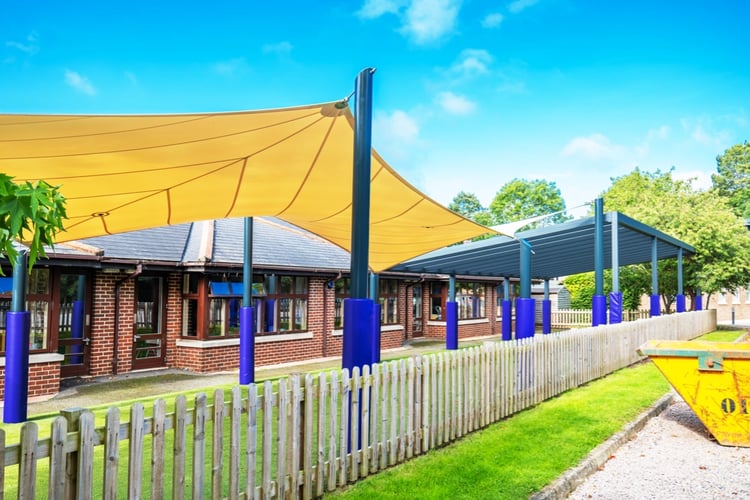
Our fabric sail shades are often a talking point in schools and businesses because they come in various vibrant colours and striking designs.
They are ideal for small areas over a playground or in an outside space in a restaurant or rest area at a business, transforming a previously unused or underused area into an enticing area to sit in.
Making a statement
The wide variety of bright colours and shapes allows you to choose a design and colour personal to you.
You can opt for one or several shades to create an original and striking new area for customers, students or staff or choose colours that match and reinforce your branding.
Designs include triangular, square or rectangular shapes with posts in each corner; conic or umbrella sails suitable to cover large areas where the number of posts has to be kept to a minimum with a single supporting mast.
Finally, perimeter shade sails are often used in areas where it’s only possible to dig small foundations. They are supported by a steel framework underneath the fabric helping to put less tension on the posts.
Protection from the sun
Like polycarbonate roofs, fabric roofs provide you with 98 per cent UV protection.
However, the fabric doesn’t allow light to shine through to the area directly below, though plenty of light enters from the sides.
Not fully rain-resistant
If you want to use your sail shade in colder, wetter weather make sure you ask for the fabric to be waterproofed.
Also bear in mind not all areas underneath can be kept dry when it rains because of the design, which may make a shade sail less useful in colder months.
Low maintenance
While our steel frames are very low maintenance and will last for many years, you will need to look after the fabric panels to keep them in tip-top condition.
You can do this by cleaning any debris that collects there to stop sagging or damage. In extreme weather, you may need to remove them.
Extensive Groundworks
You will need more extensive groundworks for a sail shade than a polycarbonate roof canopy because they need larger foundations to make sure the posts are secured rigidly.
Talk to the experts
Our Spaceshade experts have many years of experience installing canopies and shade sails to happy customers from schools and hospitals to businesses and leisure centres, as our case studies demonstrate.
They are more than happy to talk through the best design and option for you to suit your needs and budget. Contact us today.


.jpg?width=600&height=400&name=Brunts%20Academy%20dining%20canopy%20(9).jpg)
.jpg?width=600&height=400&name=Briarwood%20School%20canopy%20(4).jpg)